Recently in Filing Applications & Petitions Category

March 8, 2010

Chile: Estado protegido temporal (TPS)

Flag Chile.jpeg

The powerful earthquake that hit Chile moved the entire city of Concepcíon, Chile 3 meters to the west! When such a natural calamity strikes a particular country, the immigration lawyers at Fong & Chun in Los Angeles receive many calls and e-mails from citizens from that country about the possibility of staying in the USA, because of the problems back home.

The US government sometimes permits citizens from that country to remain in the USA -- even after their visas or landing permits have expired -- due to the emergency circumstances in the home country. This designation -- which is called Temporary Protected Status (TPS) -- is made by the US government. At the present time, Chile has not yet been designated a TPS-eligible country by the US government.

A veces, por situaciones de urgencia nacional, el gobierno estadounidense les permite a ciudadanos de algunos paises de quedar en los EE.UU. -- aunque sus visas o permisos sean vencidos. Esta designación se llama Estado Protegido Temporal (TPS, en inglés). En este momento, los ciudadanos de La República de Chile todavía no han sido nombrado como eligible por TPS por el gobierno estadounidense.

If you are from Chile and wish to contact the attorneys at Fong & Chun to discuss your options, please call to make an appointment. --jcf

Bookmark and Share
March 5, 2010

USCIS (Again) Criticized for Arbitrary Requirements

The US Court of Appeals for the Ninth Circuit (for the western part of the USA) handed down a decision on 4 March 2010 that strongly criticizes -- and rules against -- US Citizenship and Immigration Services (USCIS) for arbitrarily imposing novel substantive or evidential requirements over and above those required by immigration regulations. Fong & Chun immigration lawyers in Los Angeles have recently seen an increase in USCIS Requests for Evidence (RFEs) which ask for (a) documents which have already been submitted, (b) information which does not relate to the case at hand, and (c) proof which is not required or is irrelevant.

This case is a vindication of the rule of law, that USCIS cannot simply make up the rules as it goes along, lawlessly flying by the seat of its administrative pants. This case says that USCIS must follow the law and provide a reasonable and fair process. This case, called Kazarian v. USCIS, can be read here.

Does this mean that USCIS will now and forever cease and desist from arbitrary and capricious rulings, making up requirements outside the regulations, and creating their own rules? Of course not. It does mean that, at least here in the western region, attorneys have an additional legal precedent to correct future wrong-doing. --jcf

Bookmark and Share
January 29, 2010

Changes to Vaccination Requirements for Immigrants

Immigrants are asked to take a medical exam before being granted legal permanent resident status in the USA. As part of this exam, immigrants are required to take various vaccinations. The immigration lawyers at Fong & Chun in Los Angeles are often asked whether someone is required to take ALL the vaccinations.

Since November 2009, USCIS has delayed the processing of many "green" card applications, because new vaccinations criteria would become effective in December 2009. Beginning on 14 December 2009, the vaccinations for herpes zoster and human papilloma virus (HPV) were no longer required for immigration purposes.

After 14 December 2009, cases that have been held in abeyance should be processed. If your Adjustment of Status case was put "on hold" due to vaccination-related issues, the case should be revived now and processed. If you have not received a resolution of your vaccination-delayed Adjustment of Status by mid-February, you should contact an immigration attorney to do a follow up with USCIS. If you have questions about the vaccinations that you will be required to take, please contact us for a consultation. --jcf

Bookmark and Share
December 20, 2009

HIV Ban Lifted

Beginning January 4, 2010, applicants for visas or greencards will no longer be considered inadmissible for being HIV positive. Early last month, the Health and Human Services Department (HHS) removed HIV (human immunodeficiency virus) from the definition of a "communicable disease of public health significance."

This marks a major success by immigration advocates like Fong & Chun, LLP and HIV/AIDS health advocates. J Craig Fong was cited in a recent Los Angeles Times article as one of the few immigration attorneys in the nation who work with HIV positive immigrants and who has been extremely successful in HIV waiver applications with the USCIS to overcome this ban.

Fong & Chun, LLP applauds the Centers for Disease Control, the HHS, and USCIS in recognizing that the ban against nonimmigrant visa and permanent residency applications by HIV positive individuals was wrong. --ecf

August 24, 2009

Immigration Reform Set for 2010

Because the debates about Health Care Reform are taking so much of the Congress' energy, the Obama Administration believes that Comprehensive Immigration Reform (CIR) will not be considered by the Congress until the beginning of 2010. The immigration law firm of Fong & Chun has many clients in Los Angeles, CA and throughout the nation who would benefit from the passage of CIR. In a recent article, President Obama restated his commitment to humane immigration law reform.

Two of the most anticipated provisions of CIR would be the Development, Relief, and Education for Alien Minors Act (DREAM Act) and the Uniting American Families Act (UAFA).

The DREAM Act would allow the normalization of the immigration status of certain undocument students who were brought prior to age 16 to the United States by their parents or guardians. These students have lived and been educated in the USA, and it would be fundamentally unfair to deny them immigration status, when they did not come to the USA through their own decision, and when the USA is often the only country these students have ever really known.

UAFA would correct a long-standing inequity under immigration law and would permit US Citizens and Legal Permanent Residents to petition for and bring their permanent partners to the USA on the same footing and subject to the same conditions as traditional married couples.

Although CIR will not be debated in Congress until the beginning of 2010, we are still urging Americans to be ready to write both of their Senators and their Congressional Representative in support of CIR. Further, we are also asking Americans also to write their state governors and full city councils, encouraging them to contact Washington to urge passage of CIR.

For more information about CIR, also see the Fong and Chun blogs of
29 June 2009
26 June 2009
--jcf

July 21, 2009

International "Support" Office Opens in California

USCIS has recently opened an "International Adjudications Support Branch" in Anaheim, California. This purpose of this office is to help process some of the applications and petitions received from international USCIS offices. The office is meant to help overseas USCIS offices handle periodic fluctuations in work. We at Fong & Chun in Los Angeles have noticed that some of our immigration law clients' forms are being processed at this new office.

The office is located in the same facility as the Los Angeles Asylum Office, and it does not handle or accept inquiries, appointments, or walk-ins.

Currently, this support branch is handling I-601 Waiver cases -- except health-related waivers -- from the US Consulate-General in Ciudad Juárez, México. It is not yet known what other cases will be assigned to this office. --jcf

Bookmark and Share
July 15, 2009

Update - Delays in LPR Card Production

At the end of June 2009, we noticed that our Los Angeles immigration clients were experiencing delays in receiving their Legal Permanent Resident cards (LPR card, the so-called "green" card). This delay was apparently due to USCIS updating its card production equipment. As immigration lawyers, Fong & Chun is always concerned when USCIS delays the production of LPR cards, because such a delay creates enormous difficulties for clients.

We have recently noticed that our clients have received their LPR cards within one month of approval.

Whether the card production delay is over, or whether the California Service Center (where the majority of our clients's card are processed) has already had its equipment upgrade, we do not know. --jcf

Bookmark and Share
July 1, 2009

Trying to Save the EB-5 Employment Creation Visa

Because we are a law firm devoted exclusively to the practice of immigration law, Fong & Chun, LLP of Los Angeles gets calls frequently about the so-called "millionaire green card." The more accurate name for this would be the EB-5 Employment Creation Immigrant Visa, or just "EB-5." This sometimes controversial visa provides for conditional legal permanent resident status for persons who, after November 1990, invest $1 million (or in some cases $500,000) in a new business that employs ten US citizens (or certain other authorized workers) full-time and engage in that business through day-to-day management.

There has been much criticism of the EB-5 visa; however, US Citizenship and Immigration Services (USCIS) officials declared in February 2009 their firm commitment to the success of the EB-5 program, acknowledging the value of the program to the US economy. The USCIS Ombudsman's office has made the following recommendations for the EB-5 program:

1. Quickly finalize the Special Legislative Regulations, to alleviate the so-called "stuck" EB-5 investors who have been in limbo since 1995. Improperly documented cases can drag on for years.

2. Adjudicators should be instructed not to continually readjudicate or re-examine the validity of previously approved economic methodologies and reports. Additionally, USCIS should strive for consistency in and among adjudicators for the EB-5 cases, so that outcomes can be more predictable.

3. USCIS should issue more EB-5 published decisions, to provide guidance and predictability for attorneys and investors.

4. Better rulemaking is critical, so that rules that have been developed to date can be memorialized.

5. There should be an advisory panel to discuss issues affecting the EB-5 program. Participants should include representatives from Departments of Commerce, Treasury, State, Labor, and possibly the Small Business Administration.

6. USCIS should create and offer an operationally-sound special handling option, similar to premium processing.

7. USCIS should prioritize processing of Regional Center filings. Due to the amplified economic benefit of pooled investments for the Regional Center cases, an expedited track could be important during this economic downturn.

8. There should be more active promotion of the EB-5 program.

The EB-5 employment creation visa is a complex animal. If you are interested in applying for the EB-5 visa, please contact our office. --jcf

Bookmark and Share
June 30, 2009

Delays in LPR Card Production

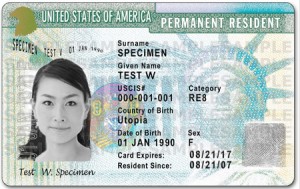
I-551.jpgThe immigration law firm of Fong & Chun in Los Angeles has recently received quite a number of phone calls from people who are waiting for issuance, re-issuance, or replacement of their US Legal Permanent Resident (LPR) cards. US Citizenship and Immigration Services (USCIS) has been experiencing delays of 2 - 3 months due to an upgrade being made in the card-production equipment.

If you have not yet had your immigration or adjustment of status interview, please remember to bring your passport with you to the interview. If your application is approved at the interview, the officer should place "the I-551 stamp" in the passport. The I-551 stamp will temporarily allow you to travel in and out of the USA and work legally, until you receive your LPR card.

If you do not have a passport, you can bring two passport-type photos with you, plus your driver license (or other government-issued I.D.), and the officer can issue you temporary proof of your status.

For those who have an LPR application approved after the interview, or if your case did not have an interview, you should bring your passport, I.D., and passport photos to a USCIS InfoPass appointment, so that USCIS can put the I-551 stamp in your passport. --jcf

Bookmark and Share
June 27, 2009

Michael Jackson's Concerts in Britain

Microphone.jpgThe immigration law firm of Fong & Chun in Los Angeles has received several calls about artists who have been involved in the preparations for the series of Michael Jackson concerts which were scheduled to take place in London beginning this summer. The performer's recent death has thrown arrangements for those concerts into chaos.

Although the Jackson concerts were to take place in the United Kingdom, extensive preparations were taking place both in the UK and in the United States. In preparation for any big rehearsal, event, performance, or concert, teams of make-up artists, costume designers, hair stylists, choreographers, dancers, back-up vocalists, special effects personnel, music arrangers, musicians, lighting engineers, etc. etc. come together to create the shows that so many enjoy. The number of people involved with a complex series of high-tech, music and dance spectaculars can be upwards of 50 -100 people, not all of them American.

Renowned performers and artists can qualify for the O-1 visa ("extraordinary ability in the sciences, arts, education, business, or athletics) to enter the USA. However, when something catastrophic happens -- like the death of a performer -- the performance or concert on which the O-1 visa is based is cancelled, the performer or artist risks falling out of legal immigration status.

For individuals who have visas which are predicated on a set of facts -- an individual employer, a detailed job description, a specific person, a particular school or academic program, etc., -- it is vital to consult a knowledgeable immigration attorney if there has been any substantial change, in order to preserve visa status. --jcf

Bookmark and Share
June 14, 2009

July 2009 Visa Bulletin Reflects Grim News for Employment-Based Applications

Those who are patiently awaiting their EB-3 and EB-2 petitions to become current probably check the Department of State's website every month for the newest visa bulletin. Many of you have probably been in the processing queue for several years, are on AC-21 extensions of your H-1B, or are relying on your work permits (EADs), and EAD renewals year after to year so you can keep working legally while you await your "greencard." Some of you are facing situations where your children face "age out" issues and even more of you are awaiting permanent residency so you can then travel legally to visit relatives in your home country. Some may waiting abroad. Nonetheless, you are all waiting and waiting...

The July 2009 visa bulletin released by the US Department of State confirms what we already know - that waiting times are painfully long and slow. But an announcement by the US Department of State's Visa Office to the American Immigration Lawyers Association (AILA), confirms what we have dreaded along: that the situation is "dire" and will amount to extended delays beyond what you have already endured.

The Visa Office has already indicated that the worldwide cutoff date for EB-3 will be set on or around March 1, 2003. With any luck, we may see quick advances in that category near the beginning of 2010, but I'm not counting on it.

Based on current EB-3 demand, India's cut off date in October 2009 will be set at November 1, 2001 and China and Mexico only slightly better March 1, 2003 cut off dates. However, given how tough USCIS has been lately in adjudicating I-140s and even adjustment of status petitions, a lot can change between now and October 1, 2009. You should remember that these estimations from the Visa Office are just estimates.

From bad to worse: the EB-2 estimates for China and India. Come October 1, 2009, the Visa Office expects that the cut off dates for China and India will both be January 1, 2000.

EB-1 for China and India will probably experience a cut-off date in August, too.

As for religious workers who can now file concurrent I-360 and I-485 applications, you are forewarned as well. This year, the Department of State has announced that a surge of applications may also cause a cut off date before September. But since this category is still current, you should take advantage of it now!

This report underscores the need for immigration reform. Without legislative relief, these backlogs will just continue to grow. It's unrealistic to think that employers will continue to play this waiting game. The most talented of workers will be recruited by companies abroad. And if US employers have to, they will continue to outsource to the very professionals who could have generated significant revenue for our government if they were in the US paying state and federal income taxes. They could also be contributing to another program on the brink: social security. --ecf

Bookmark and Share
May 4, 2009

Waiver Appointments at Ciudad Juarez, México

Fong & Chun has been informed that the US Consulate-General at Ciudad Juárez is modifying the way it processes waivers. Immigrant visa applicants who seek a waiver of a ground of inadmissibility at Ciudad Juárez, México should expect to wait at least two months for the waiver interview.   Our Los Angeles clientele includes many Méxican nationals, and those who to Mexico.jpgare applying for waivers will experience this delay and should plan accordingly.

Because applicants have flooded the Consulate with requests for waivers, and because many of those applicants do not even qualify for the waiver in the first place, the immigrant visa unit at the Consulate has been inundated.  The result has been (a) the imposition of a 48-hour waiting period before an applicant can even telephone to make a waiver interview appointment, and (b) a wait of at least two months for the appointment.

Applicants should make plans in advance, because unless an applicant has a valid visa, it is unlikely that an applicant can return to the USA prior to the waiver interview.  That means that applicants will need to anticipate an extended stay in México, until the waiver is granted.  Further, because of safety considerations, applicants may wish to pass that waiting time in a city other than Juárez.  If you have questions about how waivers work and whether you qualify, please feel free to contact us.  --jcf


Bookmark and Share
April 30, 2009

I-90 Filing Address has Changed

US Citizenship & Immigration Services (USCIS) has announced that all I-90 Applications to Replace Permanent Resident Card must be sent to an address in Phoenix, Arizona.   This change affects ANYone who is filing a paper I-90.  As immigration lawyers in Los Angeles, Fong & Chun often gets phone calls seeking help to follow up on lost or delayed applications, and despite the instructions that may appear on the I-90 instruction sheet, the new Phoenix addresses went into effect on 27 April 2009. If you do not use these new addresses for your I-90, the application (and fee) will likely be rejected, returned, or lost, and the issuance of your LPR card will be delayed.

Beginning on 27 April 2009, all I-90s must be sent to a lockbox facility:
USCIS
PO Box 21262
Phoenix, AZ 8f5036

USPS Express Mail and other couriers may use:
USCIS
Attn: I-90
1820 Skyharbor Circle S, Flr. 1
Phoenix, AZ 85034

--jcf


Bookmark and Share
April 23, 2009

"Funny, you don't LOOK gay."

Because Fong & Chun sees many gay men and lesbians at our immigration law offices in Los Angeles, we get inquiries about asylum based on sexual orientation.  To get asylum, the applicant must demonstrate to a hearing officer or Immigration Judge (IJ) that s/he would suffer persecution if s/he returned to the home country.  The US Tenth Circuit Court of Appeals just issued a decision in the case of Razkane vs. Holder, No. 08-9519 (10th Cir., filed Apr. 21, 2009).

In this case, a man from Morocco had overstayed in the USA because he was afraid to return to  his home country because, as a gay man, he would be subjected to torture and other persecution. At the initial hearing, the IJ accepted the idea that a gay man might be persecuted in Morocco.  However, the IJ denied the request for asylum, because in the IJ's opinion Razkane's appearance did not have anything that would mark him as being gay, "[he] does not dress in an effeminate manner or affect any effeminate mannerisms."  In other words, the IJ didn't think Razkane looked gay enough!

The appellate court criticized the IJ, noting that this "style" of judging was "unhinged" from the need for substantial evidence and would result in terrible results.  The judges noted that stereotyping of this kind would not be entertained in a case regarding religion or race, and it will not now be tolerated in a case of a gay man seeking asylum!  --jcf


Bookmark and Share
April 20, 2009

2009 Immigration Poverty Guidelines

Here at Fong & Chun, we handle many cases for which a "financial sponsor" must submit an I-134 or I-864 Affidavit of Support.  These "sponsors" must have resources and income sufficient to meet US government "poverty guidelines."

The US Department of Health and Human Services sets the poverty guidelines annually.  The poverty guidelines in effect for 2009 are set forth here.  All cases filed after 1 March 2009 are expected to meet the standard set in the new poverty guideline.  --jcf

Bookmark and Share