Recently in Labor Certifications (PERM) Category

December 20, 2009

HIV Ban Lifted

Beginning January 4, 2010, applicants for visas or greencards will no longer be considered inadmissible for being HIV positive. Early last month, the Health and Human Services Department (HHS) removed HIV (human immunodeficiency virus) from the definition of a "communicable disease of public health significance."

This marks a major success by immigration advocates like Fong & Chun, LLP and HIV/AIDS health advocates. J Craig Fong was cited in a recent Los Angeles Times article as one of the few immigration attorneys in the nation who work with HIV positive immigrants and who has been extremely successful in HIV waiver applications with the USCIS to overcome this ban.

Fong & Chun, LLP applauds the Centers for Disease Control, the HHS, and USCIS in recognizing that the ban against nonimmigrant visa and permanent residency applications by HIV positive individuals was wrong. --ecf

October 8, 2009

PERM Delays: Audits and Backlogs

PERM cases are backlogged now to December 2008. So if you have a PERM case pending that was submitted more than a year ago, DOL may entertain an email inquiry from you. But if your case was submitted in October 2008 or after, you still have a long wait ahead of you and yes, DOL does not want to hear from you at all...

USDOL reports that they have approximately 65,800 cases in the processing queue for PERM. This number also includes cases that are on appeal. Of these cases, approximately 24,600 or about 37% of the cases were issued audits.

For people waiting for final adjudication after submitting an audit response, DOL informs us that they are still working on audited cases from October 2007!

This is obviously bad news for applicants and employers who are waiting patiently for these processing queues to move forward. If you have been in this queue already, you already know that PERM has slowed down to a crawl. For anyone thinking of filing a new PERM case, be warned that since it is taking so long for an initial or final adjudication, employers and employees must be extremely careful about how their case is presented and hope that their case goes through without the additional delay of an audit. Further, take care to cover yourself and maintain status throughout the anticipated pendency of a PERM application. If you have questions about PERM or presenting a new case, contact the attorneys at Fong & Chun for a free initial consultation. ---ecf

Bookmark and Share
June 27, 2009

Michael Jackson's Concerts in Britain

Microphone.jpgThe immigration law firm of Fong & Chun in Los Angeles has received several calls about artists who have been involved in the preparations for the series of Michael Jackson concerts which were scheduled to take place in London beginning this summer. The performer's recent death has thrown arrangements for those concerts into chaos.

Although the Jackson concerts were to take place in the United Kingdom, extensive preparations were taking place both in the UK and in the United States. In preparation for any big rehearsal, event, performance, or concert, teams of make-up artists, costume designers, hair stylists, choreographers, dancers, back-up vocalists, special effects personnel, music arrangers, musicians, lighting engineers, etc. etc. come together to create the shows that so many enjoy. The number of people involved with a complex series of high-tech, music and dance spectaculars can be upwards of 50 -100 people, not all of them American.

Renowned performers and artists can qualify for the O-1 visa ("extraordinary ability in the sciences, arts, education, business, or athletics) to enter the USA. However, when something catastrophic happens -- like the death of a performer -- the performance or concert on which the O-1 visa is based is cancelled, the performer or artist risks falling out of legal immigration status.

For individuals who have visas which are predicated on a set of facts -- an individual employer, a detailed job description, a specific person, a particular school or academic program, etc., -- it is vital to consult a knowledgeable immigration attorney if there has been any substantial change, in order to preserve visa status. --jcf

Bookmark and Share
June 14, 2009

July 2009 Visa Bulletin Reflects Grim News for Employment-Based Applications

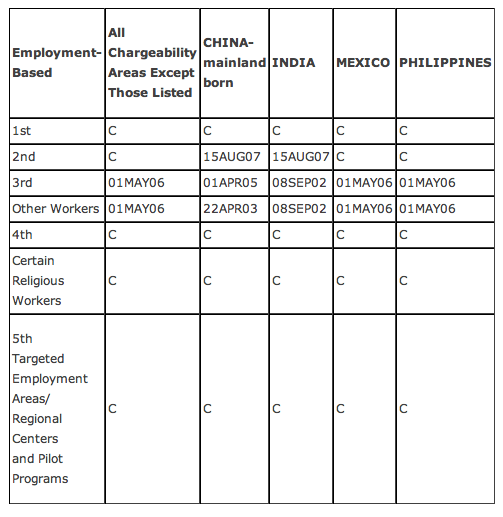
Those who are patiently awaiting their EB-3 and EB-2 petitions to become current probably check the Department of State's website every month for the newest visa bulletin. Many of you have probably been in the processing queue for several years, are on AC-21 extensions of your H-1B, or are relying on your work permits (EADs), and EAD renewals year after to year so you can keep working legally while you await your "greencard." Some of you are facing situations where your children face "age out" issues and even more of you are awaiting permanent residency so you can then travel legally to visit relatives in your home country. Some may waiting abroad. Nonetheless, you are all waiting and waiting...

The July 2009 visa bulletin released by the US Department of State confirms what we already know - that waiting times are painfully long and slow. But an announcement by the US Department of State's Visa Office to the American Immigration Lawyers Association (AILA), confirms what we have dreaded along: that the situation is "dire" and will amount to extended delays beyond what you have already endured.

The Visa Office has already indicated that the worldwide cutoff date for EB-3 will be set on or around March 1, 2003. With any luck, we may see quick advances in that category near the beginning of 2010, but I'm not counting on it.

Based on current EB-3 demand, India's cut off date in October 2009 will be set at November 1, 2001 and China and Mexico only slightly better March 1, 2003 cut off dates. However, given how tough USCIS has been lately in adjudicating I-140s and even adjustment of status petitions, a lot can change between now and October 1, 2009. You should remember that these estimations from the Visa Office are just estimates.

From bad to worse: the EB-2 estimates for China and India. Come October 1, 2009, the Visa Office expects that the cut off dates for China and India will both be January 1, 2000.

EB-1 for China and India will probably experience a cut-off date in August, too.

As for religious workers who can now file concurrent I-360 and I-485 applications, you are forewarned as well. This year, the Department of State has announced that a surge of applications may also cause a cut off date before September. But since this category is still current, you should take advantage of it now!

This report underscores the need for immigration reform. Without legislative relief, these backlogs will just continue to grow. It's unrealistic to think that employers will continue to play this waiting game. The most talented of workers will be recruited by companies abroad. And if US employers have to, they will continue to outsource to the very professionals who could have generated significant revenue for our government if they were in the US paying state and federal income taxes. They could also be contributing to another program on the brink: social security. --ecf

Bookmark and Share
May 4, 2009

Waiver Appointments at Ciudad Juarez, México

Fong & Chun has been informed that the US Consulate-General at Ciudad Juárez is modifying the way it processes waivers. Immigrant visa applicants who seek a waiver of a ground of inadmissibility at Ciudad Juárez, México should expect to wait at least two months for the waiver interview.   Our Los Angeles clientele includes many Méxican nationals, and those who to Mexico.jpgare applying for waivers will experience this delay and should plan accordingly.

Because applicants have flooded the Consulate with requests for waivers, and because many of those applicants do not even qualify for the waiver in the first place, the immigrant visa unit at the Consulate has been inundated.  The result has been (a) the imposition of a 48-hour waiting period before an applicant can even telephone to make a waiver interview appointment, and (b) a wait of at least two months for the appointment.

Applicants should make plans in advance, because unless an applicant has a valid visa, it is unlikely that an applicant can return to the USA prior to the waiver interview.  That means that applicants will need to anticipate an extended stay in México, until the waiver is granted.  Further, because of safety considerations, applicants may wish to pass that waiting time in a city other than Juárez.  If you have questions about how waivers work and whether you qualify, please feel free to contact us.  --jcf


Bookmark and Share
April 22, 2009

Labor Certification (PERM) Processing Times

Everyone has noticed how painfully slow labor certification (PERM) cases have become.  What was normally about a 45- 60 day adjudication period has now stretched out to 7- 9 months, on average.  Last week, the Dept. of Labor (DOL) announced that as of mid-March, they were working on cases that were originally filed in July 2008, and these are cases that were not selected for an audit.

A grim confirmation for cases that in the audit queue:  DOL confirmed they are now working on initial filing dates from September  2007.  Finally, for cases awaiting a response on appeal:  the DOL is working on cases with a priority date of June 2007.    

Gone are the days of re-filing PERM cases within a few months in case of a denial.  If it is taking 9 months for an initial adjudication and another 12 months for DOL's response to an audit response, applicants and employers will end up waiting over 18 months to find out if their PERM case is successful or not.  If your PERM case is denied, you will not know until 18 months after your initial filing!  Employers will have to conduct new advertisng and recruitment which means yes, starting from scratch.

While applicants and their employers may have no control over how long it will take DOL to adjudicate a labor certification application, finding the right immigration visa attorney to help you submit your PERM case is entirely within your control and discretion.  Take the time to find a qualified immigration attorney to maximize your chances at getting your PERM case filed successfully the first time.
--ecf
 
Bookmark and Share
April 9, 2009

May Visa Bulletin: EB-2 Stays Current, EB-3 Now Unavailable (U)

The May Visa Bulletin shows that all employment-based third preference (EB-3) category visas are listed as "U," or "unavailable."  This means that the USCIS cannot issue any immigrant visas (greencards) to people who are being sponsored under the EB-3 category until next October, when the new fiscal year begins and when immigrant visa numbers are replenished.  This will affect hundreds of thousands of applicants who have been waiting for their greencard cases to become "current" for several years.  Some applicants have been waiting since 2001 and even longer!  What many applicants do not realize is that they could be eligible for an EB-2 or "second preference" category greencard if they meet certain requirements.  Most people who are eligible for the EB-2 category are people who hold a master's degree but some applicants who have more than 5 years of experience in their field may also qualify.

You should contact an immigration visa attorney if you believe you are eligible for an EB-2 category greencard application.  Experienced immigration attorneys who regularly represent employers in the labor certification process (PERM) can identify strong second preference greencard cases.  Although this is considered a more difficult case to present to the Department of Labor and to the USCIS, the benefits are immense.  Instead of waiting 7 or more years for a greencard through the EB-3 category, waiting times under the EB-2 category can be reduced to 2-3 years, possibly less if you use a competent immigration attorney.

I am most proud of a case involving a professional worker who had many years of experience in her field of work.  Even though she did not have a Master's degree, we decided to pursue a more difficult EB-2 PERM case because one of her children was turning 21 years old within the year.  If we chose the EB-3 route, this child would be considered "aged-out" upon her 21st birthday and that child would never derive a greencard from her mother's petition.  We decided to take a chance on the more difficult PERM case and earlier this year, the entire family (eldest child included) received their greencards thanks to our decision to file the EB-2 case and also because we benefitted from the Child Status Protection Act (CSPA) which can "freeze" a child's age for immigration purposes.

Some clients think that if they already have an EB-3 case pending, they cannot also file for an EB-2.  This is not true if certain requirements are met.  If you have a long-pending EB-3 case, check with an immigration attorney to see if you qualify for an EB-2 second preference application.  

--ecf

Bookmark and Share