Recently in Free Trade (TN, E-3) Category

December 20, 2009

HIV Ban Lifted

Beginning January 4, 2010, applicants for visas or greencards will no longer be considered inadmissible for being HIV positive. Early last month, the Health and Human Services Department (HHS) removed HIV (human immunodeficiency virus) from the definition of a "communicable disease of public health significance."

This marks a major success by immigration advocates like Fong & Chun, LLP and HIV/AIDS health advocates. J Craig Fong was cited in a recent Los Angeles Times article as one of the few immigration attorneys in the nation who work with HIV positive immigrants and who has been extremely successful in HIV waiver applications with the USCIS to overcome this ban.

Fong & Chun, LLP applauds the Centers for Disease Control, the HHS, and USCIS in recognizing that the ban against nonimmigrant visa and permanent residency applications by HIV positive individuals was wrong. --ecf

October 2, 2009

H-1B Quota, Fraud Detection, On-site interviews

The H-1B quota has now reached approximately 46,700 and although the USCIS has announced that they've received approximately 20,000 advanced degree applications, it still continues to accept advanced degree cases.

I have been fielding a lot of questions about whether a person is still "in H-1B status" even if they are no longer working for the employer who sponsored them. Simply put, the answer is "no." When H-1B workers are petitioned for by a specific employer, not only are they expected to work for that employer only (unless they have a concurrently approved H-1B for a separate employer), but they must always comply with the original terms of the H-1B petition. Any changes considered to be material to the employment must be reported to the US Department of Labor and possibly to the USCIS.

Further, H-1B employees are considered to be out of status if they lose their jobs or quit working for the H-1B sponsor. And as of late, the USCIS has been conducting random on-site visits to H-1B employers, interviewing the foreign worker(s), HR or the company owner, as well as verifying the terms and conditions of their work.

It shouldn't be a surprise to people that the Department of Homeland Security is utilizing their resources to crack down on employers and employees under the H-1B program.

Just 3 days ago, Senator Grassley of Iowa wrote a letter to USCIS Director, Alejandro Mayorkas, imploring him to "ensure accountability" in the H-1B program. This wasn't the first time Sen. Grassley has done so. Earlier this year, Sen. Grassley called out "Microsoft" for their usage of the H-1B program as well.

If your company is facing lay offs or you have lost your H-1B job, you need advice on how to maintain status (if possible) and/or guidance on what you may face in future applications for work authorization or work visas. ---ecf

Bookmark and Share
June 27, 2009

Michael Jackson's Concerts in Britain

Microphone.jpgThe immigration law firm of Fong & Chun in Los Angeles has received several calls about artists who have been involved in the preparations for the series of Michael Jackson concerts which were scheduled to take place in London beginning this summer. The performer's recent death has thrown arrangements for those concerts into chaos.

Although the Jackson concerts were to take place in the United Kingdom, extensive preparations were taking place both in the UK and in the United States. In preparation for any big rehearsal, event, performance, or concert, teams of make-up artists, costume designers, hair stylists, choreographers, dancers, back-up vocalists, special effects personnel, music arrangers, musicians, lighting engineers, etc. etc. come together to create the shows that so many enjoy. The number of people involved with a complex series of high-tech, music and dance spectaculars can be upwards of 50 -100 people, not all of them American.

Renowned performers and artists can qualify for the O-1 visa ("extraordinary ability in the sciences, arts, education, business, or athletics) to enter the USA. However, when something catastrophic happens -- like the death of a performer -- the performance or concert on which the O-1 visa is based is cancelled, the performer or artist risks falling out of legal immigration status.

For individuals who have visas which are predicated on a set of facts -- an individual employer, a detailed job description, a specific person, a particular school or academic program, etc., -- it is vital to consult a knowledgeable immigration attorney if there has been any substantial change, in order to preserve visa status. --jcf

Bookmark and Share
June 14, 2009

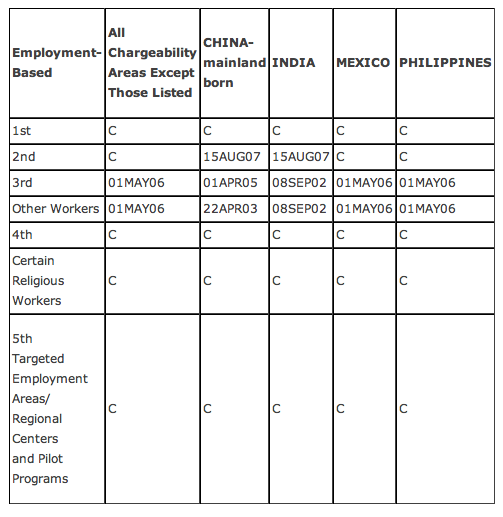
July 2009 Visa Bulletin Reflects Grim News for Employment-Based Applications

Those who are patiently awaiting their EB-3 and EB-2 petitions to become current probably check the Department of State's website every month for the newest visa bulletin. Many of you have probably been in the processing queue for several years, are on AC-21 extensions of your H-1B, or are relying on your work permits (EADs), and EAD renewals year after to year so you can keep working legally while you await your "greencard." Some of you are facing situations where your children face "age out" issues and even more of you are awaiting permanent residency so you can then travel legally to visit relatives in your home country. Some may waiting abroad. Nonetheless, you are all waiting and waiting...

The July 2009 visa bulletin released by the US Department of State confirms what we already know - that waiting times are painfully long and slow. But an announcement by the US Department of State's Visa Office to the American Immigration Lawyers Association (AILA), confirms what we have dreaded along: that the situation is "dire" and will amount to extended delays beyond what you have already endured.

The Visa Office has already indicated that the worldwide cutoff date for EB-3 will be set on or around March 1, 2003. With any luck, we may see quick advances in that category near the beginning of 2010, but I'm not counting on it.

Based on current EB-3 demand, India's cut off date in October 2009 will be set at November 1, 2001 and China and Mexico only slightly better March 1, 2003 cut off dates. However, given how tough USCIS has been lately in adjudicating I-140s and even adjustment of status petitions, a lot can change between now and October 1, 2009. You should remember that these estimations from the Visa Office are just estimates.

From bad to worse: the EB-2 estimates for China and India. Come October 1, 2009, the Visa Office expects that the cut off dates for China and India will both be January 1, 2000.

EB-1 for China and India will probably experience a cut-off date in August, too.

As for religious workers who can now file concurrent I-360 and I-485 applications, you are forewarned as well. This year, the Department of State has announced that a surge of applications may also cause a cut off date before September. But since this category is still current, you should take advantage of it now!

This report underscores the need for immigration reform. Without legislative relief, these backlogs will just continue to grow. It's unrealistic to think that employers will continue to play this waiting game. The most talented of workers will be recruited by companies abroad. And if US employers have to, they will continue to outsource to the very professionals who could have generated significant revenue for our government if they were in the US paying state and federal income taxes. They could also be contributing to another program on the brink: social security. --ecf

Bookmark and Share